
Yes, you can open a US bank account from Canada without a US address. At least one major Canadian bank’s cross-border program accepts applicants who live in Canada, with no US address, no US credit score, and no Social Security number. The harder question is whether you need a US account at all, or whether a US-dollar account at a Canadian bank covers your situation for less. This guide sets out both routes, what each requires, what each costs, and how to keep currency conversion fees from eating into your money.
TL;DR
-
A Canadian address is enough for some cross-border US accounts. You are typically asked for ID, your SIN (Social Insurance Number), and your Canadian residential details, not a US address.
-
A US-dollar account at a Canadian bank holds USD, but it can be limited for US payment systems. A true US account gives you better access to them.
-
Account fees are small next to conversion costs. The Financial Consumer Agency of Canada (FCAC) reports bank markups of roughly 1% to 4% over the mid-market rate.
-
If you hold US property or other foreign assets worth more than $100,000 in total, you may have to file a CRA information return (Form T1135).
-
Compare the rate you are quoted with the Bank of Canada rate before every large transfer.
Table of Contents
Why the address question comes up
Most people asking this are in one of a few positions. Snowbirds are buying or renting in Florida or Arizona and want to pay bills there. Homeowners are closing a US purchase or sale. Cross-border workers get paid in USD. Students pay US tuition. Travelers simply want US dollars without paying a conversion fee on every swipe.
In each case, a US account solves a practical problem: the money arrives or leaves in USD, so you convert once, on your terms, instead of every time you spend. The address requirement is the obstacle people expect, because US banks normally verify a US residential address for domestic customers. Cross-border programs from Canadian banks are built around that gap and use your Canadian address instead.
Two routes to US dollars
There are two different products, and they are often confused.
Route 1: a US-dollar account at a Canadian bank. You stay inside the Canadian system. The account is held in USD, deposits are eligible for CDIC coverage under the usual rules for foreign-currency deposits, and you apply at your own bank. It does not give you a US routing number for domestic US payments.
Route 2: an account at a US bank, opened from Canada. You become a customer of a US institution, usually through a cross-border program run by a bank that operates in both countries. You get a US account number you can use for US direct deposits, bill payments, and US billing.
| Feature | USD account at a Canadian bank | US bank account opened from Canada |
|---|---|---|
| Currency held | USD | USD |
| US address needed | No | No, in cross-border programs |
| Application | Often at a branch or online | Can be fully online in some programs |
| Access to US payment systems | Can be limited | Better access |
| Deposit insurance | CDIC | FDIC, up to US$250,000 per ownership category |
| Best for | Holding USD, travel, occasional US spending | US payroll, US bills, property, subscriptions |
The differences matter most for recurring US payments. Canadian USD accounts can lack support for ACH (the US electronic bank-to-bank system), and US-based subscriptions or billing can require a local account.
What you need to apply from Canada
Requirements vary by bank, but the pattern is consistent.
-
Age and residence. One cross-border program requires you to be 18 or older and to live in Canada or the US. Others tie the age to your province’s age of majority.
-
Canadian address. This is what replaces the US address. If you have recently moved, make sure the address on your ID and your proof of address match what you enter. Movers who are still arranging a place to live can rent safely from anywhere, so they have a stable Canadian address on file before they apply.
-
Government photo ID. A driver’s license or passport works. The same program says you can apply entirely online in about five minutes with your Canadian address, SIN (or SSN if you have one), and photo ID.
-
SIN or SSN. You do not need a Social Security number. Your SIN is what Canadian-resident applicants normally provide.
-
Tax forms. Some institutions ask you to complete a form such as a W-8BEN to confirm you are not a US tax resident. If you are a US citizen or green-card holder, the rules differ, so confirm with the bank.
-
Opening deposit. The program above lists a US$50 opening deposit.
Credit unions and some Canadian USD accounts add an in-person step. One prairie credit union, for example, requires in-person identity confirmation with photo ID and SIN, and charges a $5 membership fee. Budget time for a branch visit if you choose this route.
What it costs to keep the account
Account fees are modest and easy to compare. Here is what the banks themselves publish.
-
A cross-border US checking account: US$0 for the first year with a cross-border banking bundle, otherwise US$39.50 a year, with 10 debits included (US$1 each after) and no minimum balance. A premium tier is US$99.50 a year with unlimited debit transactions. Promotional pricing changes, so check the bank’s page for the current terms.
-
A Canadian bank’s USD chequing account: US$0 monthly fee with US$1.25 per debit, per the bank’s page. The fee schedule adds that transaction fees are waived when you hold US$1,500 or more at the end of each day, and that its Borderless Plan costs US$4.95 a month (the schedule is dated October 2021, so confirm current figures).
-
A branch-only USD account: a US$5,000 minimum balance to earn interest, US$1.25 per cheque and US$2 per bill payment, and no ATM, online or debit-card transactions on that account.
-
A USD savings account with debit access: one big bank’s US$ Personal Account lets you deposit and withdraw USD at its banking centers or US currency ATMs in Canada without conversion, using a Canadian debit card.
Compare more accounts side by side in our guide to USD chequing accounts in Canada, which covers fees, features and real costs.
The cost that matters: getting money in
Opening the account is the cheap part. Filling it is where the money goes. When your bank converts Canadian dollars into US dollars, the markup sits inside the exchange rate and is not shown as a separate fee. The FCAC’s banking fees review says bank currency conversion markups typically range from about 1% to 4% relative to the mid-market rate (the midpoint between buy and sell prices, which is close to the Bank of Canada rate).
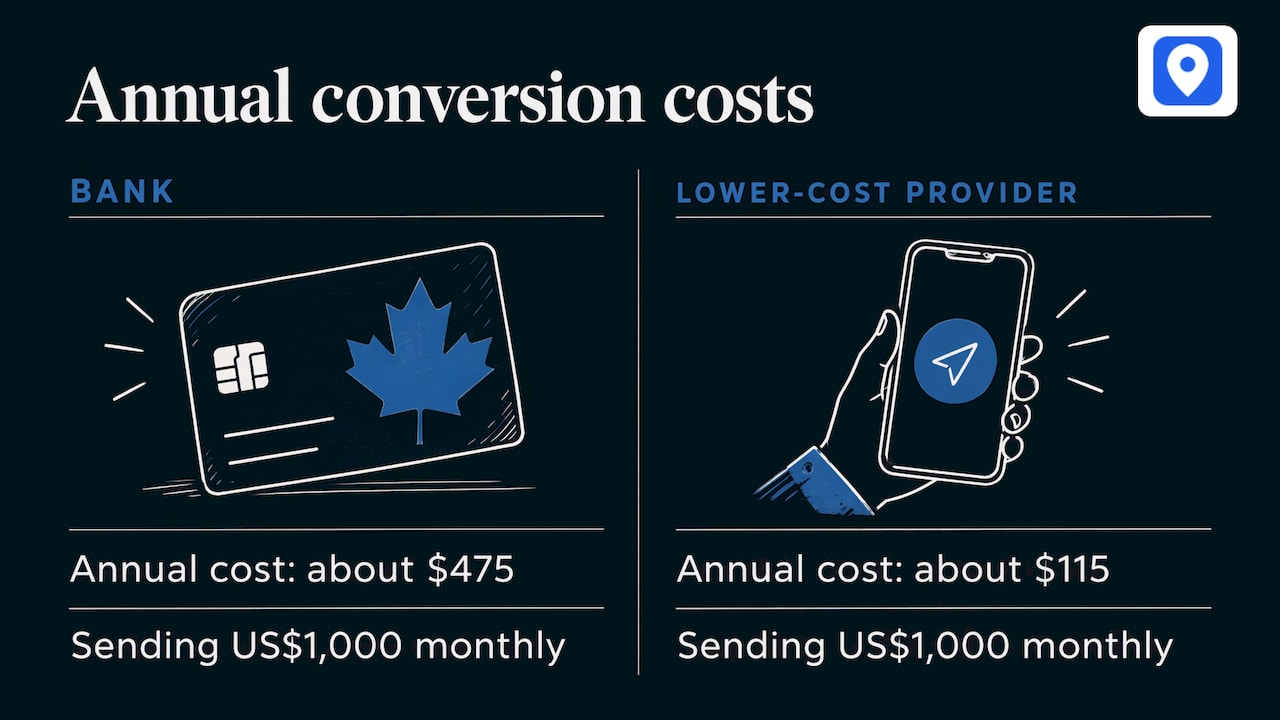
Its worked example is useful. Someone sending US$1,000 a month through a bank could pay about $475 above mid-market over a year, versus about $115 with a lower-cost provider. That is a difference of about $360 a year on a modest amount, based on rates recorded June 23, 2026. A snowbird moving US$50,000 faces a much larger gap at the same percentage.
Exchange rates move every day. Our CAD to USD page showed 1 CAD = 0.7009 USD on November 13, 2026, and the USD to CAD page showed 1 USD = 1.4267 CAD that day. Use those as snapshots, not quotes. Your test is simple: take the rate you are offered, divide it against the Bank of Canada rate for the same day, and the gap is your markup.
Moving money between your Canadian and US accounts
The transfer method decides what you pay. Options include:
-
Transfers within one bank’s cross-border program. One program offers free instant online transfers of up to $25,000 per transfer between its Canadian and US accounts, and a Canadian bank’s USD page lists no transfer fee for Visa Direct transfers up to $2,500 a day to a linked US account. A transfer fee of zero does not mean a zero conversion markup, so check the rate too.
-
Wire transfers. Common for larger sums such as a property closing. Fees and intermediary charges can add up: see our guides to wire transfers from Canada to the USA and intermediary bank fees.
-
Interac e-Transfer. It does not go to US accounts. Our page on what works instead of Interac e-Transfer to the USA lists the alternatives.
-
Online money transfer services. Often cheaper on the rate than a bank for larger conversions, and regulated as money services businesses, which is why we check each one’s FINTRAC registration.
Which route fits your situation
Snowbirds. If you are paying a US landlord, utilities, and a Medicare supplement or insurance every month, a US account with US bill-pay and direct debit avoids repeated conversions. Convert a larger sum once, at the best rate you can find, and draw it down.
Homeowners buying or selling US property. A US account is practical for a mortgage, property tax, and insurance. For the closing itself, wire costs and rate matter most. If you sell, you will usually want to bring the proceeds back; our guide to moving money from the USA to Canada covers cost and speed.
Cross-border workers paid in USD. A US account that accepts direct deposit lets you keep USD pay in USD and convert on your schedule. A Canadian USD account may not accept the same payment rails, so confirm with payroll first.
Students paying US tuition. You may not need an account at all. Many schools take a wire or a payment portal. If you will pay in several installments, a USD account saves you from converting each time.
Travellers. For travel, a Canadian USD account with a debit card or a multi-currency account is usually enough. Credit cards add foreign transaction fees, and airport counters are expensive: see airport currency exchange rates.
A third option is a multi-currency account, which can hold several currencies, including GBP, EUR, AUD and NZD alongside CAD and USD, without a US bank relationship.
Taxes and reporting
Holding a US account does not by itself make you a US taxpayer, but it does create Canadian reporting questions. The CRA requires Canadian residents to file Form T1135 if they own specified foreign property with a total cost above $100,000 at any time in the year. Funds held in a foreign bank account count toward that total, along with property like a US condo you rent out. The CRA’s compliance study reports that penalties for this form were assessed on 10,040 taxpayers in fiscal year 2017-18, so the form is actively checked.
Interest earned in USD is reported in Canadian dollars on your Canadian return. Before you move a large sum, speak to an accountant or the CRA about your own situation, particularly if you are a US citizen or green-card holder, who face separate US filing rules.
How we compare these options
Our comparisons measure each provider against the Bank of Canada’s daily rate, so you see the real cost of a transfer before you make it. Every listing shows the date it was checked, and we verify providers in the FINTRAC registry and score them by BBB rating, published rates, and customer reviews. No provider pays for placement or ranking.
Find the best rate for filling your account
Once you have chosen between a Canadian USD account and a US account, the next saving is in the conversion. Our comparison of currency exchange providers across Canada lists banks, online transfer services and local exchange storefronts side by side with rates and fees checked against the Bank of Canada’s rate. Our free calculators let you test an amount, and the historical rates page shows monthly and yearly averages since 2017 so you can see how today’s quote sits in context.

If you will be selling US dollars later, see where to get the best rate when selling USD.
A short checklist before you apply
-
Decide what the account is for: holding USD, receiving US pay, or paying US bills.
-
Gather photo ID, SIN, and proof of your Canadian address.
-
Confirm whether the application is online or at a branch.
-
Add up the annual fee, per-debit fees, and minimum balance.
-
Compare the exchange rate for funding the account with the Bank of Canada rate.
-
Note the T1135 threshold if your foreign holdings could pass $100,000.
FAQ
Can I open a US bank account if I have no US address and no SSN?
Yes, through cross-border programs designed for people living in Canada. You provide your Canadian address, SIN, and government photo ID. Some institutions also request a W-8BEN form confirming you are not a US tax resident.
Can I open a US dollar account in Canada online?
Often yes, though it depends on the bank. You can apply for a cross-border US checking account entirely online, while some Canadian USD accounts, including the branch-only one above, require a visit.
Is money in a US account from Canada insured?
A US account in a cross-border program is FDIC insured up to US$250,000 per ownership category. Foreign-currency deposits at Canadian banks can be covered by CDIC, subject to its rules.
Is a US bank account cheaper than a Canadian USD account?
Not automatically. Annual or per-debit fees are small, and the higher cost is the exchange rate when you fund the account. Compare the rate against the Bank of Canada rate, whichever account you choose.