
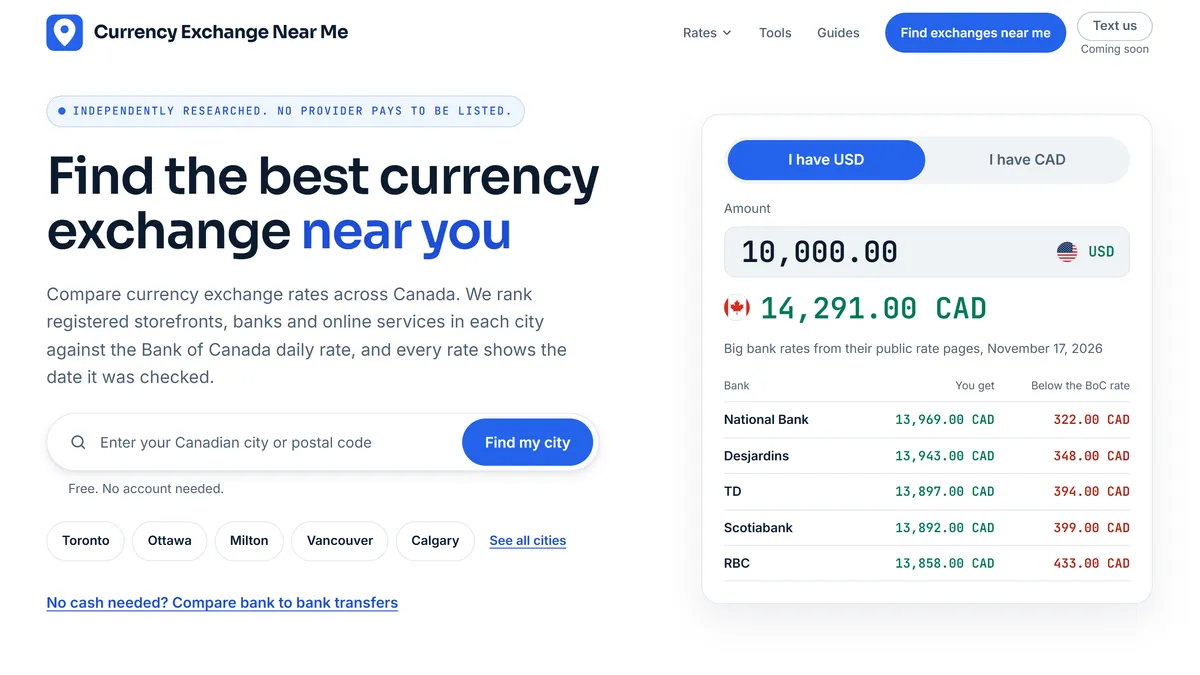
To transfer money from the USA to Canada at the lowest cost, compare the total CAD your recipient receives, not the advertised fee. Each provider’s exchange rate, its transfer fee and the delivery method set that total. The Bank of Canada published the US dollar at 1.4298 Canadian dollars on 16 November 2026, and the gap between that reference and the rate you are quoted is where most of the cost sits. We compare providers against that benchmark, so you can see the cost before you send.
This guide is for people moving US dollars into Canada: snowbirds bringing savings home, sellers of US property, cross-border workers paid in USD, and families supporting a student. It also covers the reverse direction, CAD to USD, because many readers do both.
TL;DR
- Judge any transfer by the CAD amount that lands in the account. Fee, exchange-rate markup and speed together decide it.
- The Bank of Canada rate is a reference point, not a rate you can transact at. Compare every quote with it. A markup is the difference between the two, shown as a percentage.
- For a large sum, a 1% markup on US$10,000 costs about CA$143. Markups matter more than flat fees at that size.
- A bank wire needs the recipient’s name as on the account, institution number, branch transit number and account number. Wrong details are the most common cause of delay.
- Before you send, check that the provider is registered as a money services business in the FINTRAC registry.
Table of Contents
- The main ways to move USD into Canada
- What a transfer really costs
- What you need before you send
- How long does it take?
- Transfers by situation
- Sending the other way: CAD to USD, GBP, EUR, AUD and NZD
- How to check a provider is legitimate
- How we compare providers
- A short checklist before you press send
- FAQ
- Sources
The main ways to move USD into Canada
The Financial Consumer Agency of Canada (FCAC) explains that a financial institution or business sends the transaction details to an agent in the other country. The recipient may then receive cash, a bank-account deposit, or a credit to a card. In practice, a reader sending US dollars to Canada chooses among four routes.
Bank wire
A wire moves money from your US bank account to the recipient’s Canadian bank. It suits large, one-off amounts such as property proceeds. The recipient’s institution receives it over Lynx, Canada’s high-value payment system, and Payments Canada says the deposit often arrives in near real time and is final once it reaches the account. The weak point is price. Banks typically charge a flat outgoing fee and build a markup into the rate, so the headline fee understates the cost.
Online money transfer service
Online transfer services let you fund a transfer by bank debit, card or ACH (the US system for direct bank-to-bank debits) and pay out to a Canadian bank account. They usually quote a rate closer to the reference rate than a retail bank does, and the quote shows the amount the recipient receives before you confirm. Funding method changes both speed and price: card funding is typically faster but costs more than a bank debit.

Cheque or bank draft deposit
Some people deposit a US-dollar cheque into a Canadian account. It costs little in fees, but clearing can take weeks, and the bank sets the exchange rate on conversion. It suits small, non-urgent amounts, not time-sensitive purchases.
Cash pickup and card payouts
Cash pickup is for situations where the recipient has no bank account in Canada or needs the money the same day. It is usually the most expensive route per dollar. The FCAC notes that faster delivery usually costs more, and that recipients may face fees to collect the money or to use a prepaid card.
Interac e-Transfer for the last step
Some services pay out by Interac e-Transfer. Interac says sender and recipient both need Canadian bank accounts at participating institutions, and the limits, typically $2,000 to $3,000, are set by the financial institution. That makes it practical for smaller amounts, not for a down payment.
What a transfer really costs
The FCAC lists three cost layers: the transfer fee, the exchange-rate cost, and charges the recipient may pay. Federally regulated Canadian financial institutions must disclose their sending fee, but the disclosure excludes charges that may apply in the other country. The FCAC also warns that some businesses profit by using a higher-than-usual exchange rate.
That last point is the hidden markup. A provider can advertise “no fee” and still earn its margin in the rate. The test is simple:
- Find the Bank of Canada rate for the day. The Bank of Canada’s daily exchange rates are published each business day by 4:30 p.m. ET.
- Get the exact amount the recipient receives in CAD, after all fees.
- Divide the CAD received by the USD sent, and compare with the Bank of Canada rate.
The Bank of Canada says its rates are indicative averages of financial-institution quotes, so they are a yardstick and not a price anyone is obliged to offer. For that reason, a markup of a fraction of a percent is normal, and the useful question is how much more than that you are being charged.
Worked example: US$10,000 into Canada
Using the Bank of Canada’s 1.4298 for 16 November 2026 as the benchmark, US$10,000 converts to CA$14,298 at the reference rate. The table shows what different markups do to that amount. The markups are illustrative, not quotes from any provider.
| Markup over the reference rate | CAD received | Cost compared with the reference |
|---|---|---|
| 0.5% | CA$14,226.51 | CA$71.49 |
| 1% | CA$14,155.02 | CA$142.98 |
| 2% | CA$14,012.04 | CA$285.96 |
| 3% | CA$13,869.06 | CA$428.94 |
Add a flat wire fee to the 2% row and the total cost rises further. The same US$10,000 can therefore cost several hundred dollars more depending on the route, and the difference does not appear on a fee schedule.
The rate moves every business day, so the figures above are a snapshot for one date. For the latest numbers, see our USD to CAD rate page, and for the past trend, the historical exchange rates back to 2017.

Lock the rate or let it float
The FCAC suggests asking whether the amount your recipient gets depends on the rate when you pay or on the rate when they collect. For a large transfer, a rate fixed at the moment you pay removes the risk of a worse rate on arrival. A single cent of movement on US$50,000 is worth CA$500, so the question is worth asking before you confirm.
What you need before you send
Delays usually come from missing or mismatched details. For a bank wire to a Canadian account, Payments Canada lists what the sending branch needs:
- The recipient’s name, spelled as it appears on the account, and their address
- The account number
- The branch name and address, with postal code
- The 3-digit financial institution number and the 5-digit branch transit number
- The institution’s SWIFT BIC (the international bank identifier code), if available
- The amount, the value date and who pays the service fees
Payments Canada also notes that routing details for most Canadian institutions can be checked in the Financial Institutions Branch Directory. The sender will usually also need government-issued photo ID to register with a transfer service. Ask the recipient for a void cheque or a bank-issued direct deposit form: it shows the institution, transit and account numbers exactly.
How long does it take?
The FCAC says delivery can take anywhere from a few minutes to a few days, and that the quicker options usually cost more. In practice:
- Bank wire: often the same or the next business day once your bank releases it. Cut-off times and review checks can add time.
- Online services with bank-debit funding: commonly one to a few business days, since the debit from your account has to settle.
- Card-funded transfers and cash pickup: can arrive within minutes, at a higher price.
- Cheque deposits: can take weeks.
First-time and larger transfers are the most likely to be held for identity or source-of-funds checks, so send early rather than on the day the money is needed, such as a closing date.
Transfers by situation
Snowbirds moving savings back and forth
If you move money south each winter and bring some back in spring, the cost applies twice a year. Because a markup is a percentage, a small difference compounds across repeated, large transfers. Pick a method that quotes the full CAD amount upfront, and run the same three-step test each time. For converting USD you already hold, see where to sell US dollars in Canada at the best rate.
Selling US property
Sale proceeds arrive in USD, often through a closing agent. Because the amount is large, the exchange rate matters more than the fee. Ask for a quote from several providers on the closing amount, and have the Canadian account details ready before closing day. A wire is typically the practical route at this size.
Cross-border workers paid in USD
If your employer pays you in US dollars each month, the same markup repeats every pay period. Compare the CAD you actually receive with the Bank of Canada rate on payday, and check whether your employer can send the payment straight to a Canadian account.
Students and families
Money for tuition or living costs often moves in a few large instalments. Check the deadline, allow extra days for review, and confirm the recipient name matches the account exactly.
Entrepreneurs receiving US payments
If you are setting up a Canadian business that is paid by US customers, regular USD receipts are a recurring cost. Compare the CAD received against the reference rate, as above, rather than the stated fee.
Sending the other way: CAD to USD, GBP, EUR, AUD and NZD
The test works in either direction. If you send Canadian dollars to the US, the key figure is the USD the recipient receives compared with the reference rate on our CAD to USD page. The same logic applies to other major currencies you may send or receive: see the rate pages for CAD to GBP, GBP to CAD, CAD to EUR and EUR to CAD. Banks are the most common starting point, and our side-by-side pages show CAD to USD rates compared at TD and at RBC.
How to check a provider is legitimate
Before you send a large amount, check three things:
- Registration. Money services businesses operating in Canada must register with FINTRAC, Canada’s financial intelligence unit. The FINTRAC MSB registry lets you search by business name or registration number, which starts with the letter M followed by eight digits. FINTRAC says registration shows the business met the legal requirements to register, not that FINTRAC endorses it.
- Disclosure. The provider should show the fee, the exchange rate and the amount received before you pay. The FCAC advises asking about any charges the recipient may face.
- Track record. Look at reviews and complaint history. Our listings include BBB ratings alongside FINTRAC status for each provider.
How we compare providers
Currency Exchange Near Me is an independent comparison site. Every listing is independently researched, no provider pays for placement or ranking, and every provider is verified in the FINTRAC registry. We score on BBB rating, published rates and customer reviews, and compare each rate against the Bank of Canada’s. Each comparison shows the date it was checked. The full process is set out on our methodology page.
To see providers near you with their rates and details side by side, start from our Canadian currency exchange comparison, or go straight to a city page such as Toronto or Calgary.
A short checklist before you press send
- Note the Bank of Canada rate for the day and the exact CAD the recipient will get.
- Compute the effective rate: CAD received divided by USD sent.
- Confirm whether the rate is fixed when you pay.
- Verify institution, transit and account numbers with the recipient.
- Confirm the provider’s FINTRAC registration.
- Allow extra time for a first or large transfer.
FAQ
How can I send money from the US to Canada?
You can use a bank wire, an online money transfer service funded by bank debit or card, a cheque deposit, or cash pickup. For most amounts, an online service or a wire gives the best balance of cost and speed. Compare the CAD that arrives, not the fee alone.
How long does a US to Canada transfer take?
The FCAC says international transfers can take from a few minutes to a few days, and faster delivery usually costs more. Wires often arrive within a business day, while bank-debit funded transfers commonly take longer. First-time and large transfers may be reviewed.
Is the Bank of Canada rate the rate I will get?
No. The Bank of Canada publishes indicative daily rates based on averages of financial-institution quotes, so it is a benchmark. The difference between your quote and that benchmark, as a percentage, is the markup you are paying.
How do I know a transfer provider is safe?
Search for the business in the FINTRAC money services business registry, check that it shows the fee, rate and amount received before you pay, and read its reviews. Registration means it met the legal requirements to register, not that it is endorsed.