
The fastest way to send money from Canada to the US is a same-institution cross-border transfer, where you hold an account on both sides of the border, and the money moves between them in minutes. If you do not have that, the next quickest options are a same-day wire, a bank transfer arranged through online banking, and a card-based transfer. Speed always has a price, though, and it is not always the fee you see. This guide ranks the methods by real delivery time, shows what can turn an “instant” transfer into a two-day wait, and explains how to check the full cost against the Bank of Canada rate before you confirm.
TL;DR
-
The only genuinely instant route in the sources we reviewed is a cross-border bank account pair. RBC, for example, allows up to $25,000 USD per transfer between a Canadian RBC account and an RBC Bank (U.S.) account.
-
Interac e-Transfer cannot reach a US account. It sends Canadian dollars only to accounts at Canadian institutions.
-
Wires and bank transfers typically arrive in 1 to 5 business days. A wire started during banking hours can arrive the same day.
-
A fast transfer is only a good one if the exchange rate is close to the Bank of Canada rate. A “no fee” label can hide a wider markup.
-
Transfers of $1,000 or more trigger identity checks, and international transfers of $10,000 or more are reported to FINTRAC. Neither should stop a legitimate payment, but both can add steps.
Table of Contents
The fastest methods, ranked by delivery time
“Fast” means two different things: how quickly the sender completes the transfer, and how quickly the recipient can actually use the funds. The table below uses the delivery times published by the institutions themselves.
| Method | Typical delivery | Published limit | Published fee |
|---|---|---|---|
| Same-bank cross-border transfer (RBC to RBC Bank U.S.) | Instant | Up to $25,000 USD per transfer | No transfer fee |
| Wire initiated during banking hours | Same day | Varies by provider | Typically $12 to $20 more than an ACH transfer, per one Canadian provider’s help page |
| Cash pickup (TD Global Transfer with a cash-pickup partner) | Usually 2 to 4 hours | $999.99 per 24 hours | No TD fee; partner fees and rates apply |
| Card-based transfer (TD Visa Direct) | 24 to 48 hours | $2,500 per 24 hours | No TD fee |
| Online card or Interac transfer (National Bank) | 24 to 48 hours, up to 5 business days | $10 to $10,000 per transfer | $5.95 per transaction |
| Bank transfer (CIBC Global Money Transfer) | 1 to 3 business days, usually within 24 hours | Up to $100,000 CAD per transaction | No CIBC transfer fee |
| Bank transfer (TD Global Transfer) | 1 to 5 business days | $10,000 per 24 hours | No TD fee |
| Branch SWIFT wire (National Bank) | Usually 2 to 3 days | No amount limit | 0.34% commission (min. $20, max. $70) plus $15 |
Sources for each row appear in the sections below. The pattern is consistent: the higher the amount, the more you rely on wires and bank-to-bank transfers, and the more the timeline depends on cut-off times and the banks involved.
Instant: the cross-border account route
The one route that is built to be instant is moving money between two accounts you own at the same bank group, one in Canada and one in the US. RBC Cross-Border Banking lets customers who hold both a Canadian RBC account and an RBC Bank (U.S.) account send up to $25,000 USD per transfer, as often as they like, instantly and with no transfer fee, through online banking or the mobile app.
This suits some of the readers who care most about speed:
-
Snowbirds who fund a US chequing account for winter expenses and want to top it up without waiting.
-
Cross-border workers paid in USD who move part of their pay to Canada, or the reverse.
-
Homeowners who need a US account funded quickly before a closing.
A US account is also useful beyond speed. RBC Bank (U.S.) states that Canadians can open a US Direct Checking account without US residency or a US address, and that holders can use it for person-to-person payments through US apps such as Venmo, Apple Cash, Cash App, or PayPal, which a Canadian US-dollar account cannot do. For the practical steps of opening one, see our guide to a US bank account without a US address.
The catch is that “instant” refers to the transfer itself, not to the exchange rate. If the money starts in Canadian dollars, a conversion happens somewhere, and that is where the cost sits. If you already hold US dollars, a USD chequing account in Canada lets you send without converting at the moment of transfer, which removes the rate question from that payment.
Why Interac e-Transfer does not work for the US
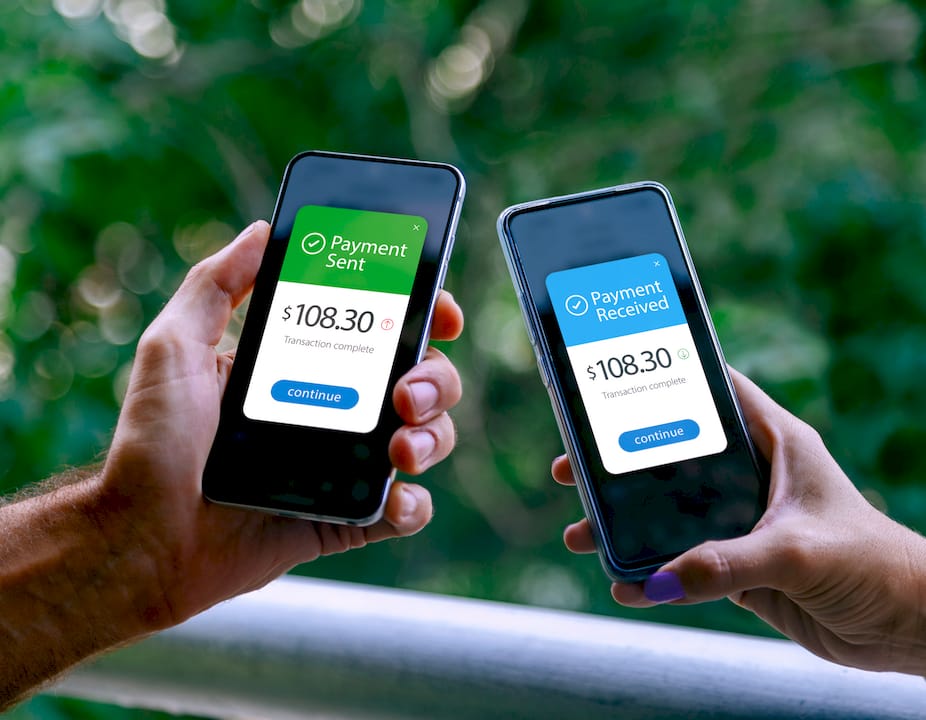
Interac e-Transfer is the fastest payment method most Canadians know, and it is the first thing people try. It does not cross the border. RBC’s account disclosures state that it sends Canadian dollars only to people or businesses holding accounts at Canadian financial institutions. A US recipient with a US bank account cannot receive one.
If someone has told you to “just e-Transfer” a US contact, the practical alternatives are a bank transfer, a wire or a card-based transfer from the table above. Our page on what works instead of Interac e-Transfer to the USA covers each substitute with its cost.
Bank transfers through online banking
If you do not have a matching US account, the Canadian big banks each offer an online international transfer. Their published terms differ in ways that matter when speed and size are both on the line.
CIBC Global Money Transfer
CIBC’s product page lists no CIBC transfer fee, a $100 CAD minimum, and a limit of $100,000 CAD per transaction from a bank account or line of credit. On a credit card, the limit is $15,000 per transaction, $40,000 weekly, and $80,000 monthly. Funds typically arrive within one to three business days, usually within 24 hours. That makes it one of the higher-limit options for a large transfer that does not need to be instant.
National Bank online transfer and wire
National Bank’s international transfer page describes two routes to the US. The online Mastercard or Interac transfer costs $5.95 per transaction, allows $10 to $10,000 per transfer, $70,000 per week and $125,000 per month, and takes 24 to 48 hours, up to five business days at most. The exchange rate is variable and set at the time of the transaction. The branch SWIFT wire has no amount limit and usually takes two to three days. It carries a 0.34% commission (minimum $20, maximum $70) plus a $15 transmission fee for Canada and the US.
TD Global Transfer
TD’s page shows three options, each with no TD transfer fee. The international bank transfer allows up to $10,000 per 24 hours ($40,000 weekly, $100,000 monthly) and arrives in one to five business days. Visa Direct allows up to $2,500 per 24 hours and arrives in 24 to 48 hours. Cash pickup is capped at $999.99 per 24 hours and is usually ready in two to four hours, with the cash-pickup partner’s own fees and rates applying.
RBC International Money Transfer
RBC’s disclosure page lists a fee of $6 for transactions of $1,000 or less and $10 for transactions over $1,000, with a daily maximum of $2,500 that can be exceeded if conditions are met. It also notes that intermediary or receiving banks may apply additional fees, which the sender often doesn’t see until the money arrives short. Our guide to intermediary bank fees on USD transfers explains how those deductions work and when they apply.
Wires versus ACH: same-day or cheaper
For USD going to a US bank account, there are two common rails. An ACH transfer is the standard electronic bank-to-bank payment in the US. A wire is a direct, faster, more expensive payment between banks.
One Canadian provider’s help center states that USD transfers to the US by ACH take 1 to 3 business days, with no fee beyond the transfer fee. A wire is same-day if initiated during banking hours and typically costs $12 to $20 more than ACH. The same page notes that most international transfers on its platform arrive in under a minute but can vary.
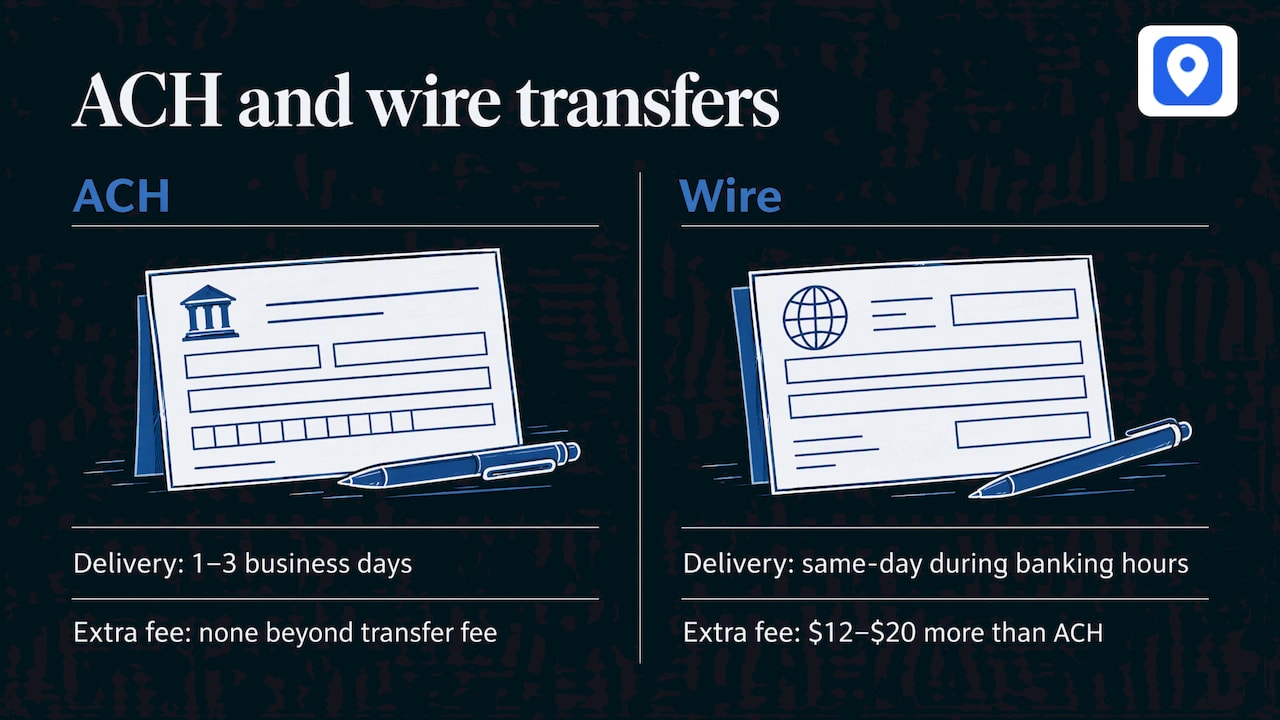
The practical rule: if you need the money today, a wire started in the morning is usually the answer. If it is needed within three days, ACH saves you the wire premium. For the full step-by-step process and cost breakdown, see our guide to a wire transfer from Canada to the USA.
What turns an instant transfer into a slow one
Published speeds are best cases. These are the factors that most often slow them down.
-
Cut-off times. Wires and ACH batches are processed during banking hours. A request that misses the cut-off is treated as next business day. Start the transfer early in the day.
-
Weekends and holidays. Canadian and US bank holidays do not fully overlap, so a transfer can stall when either side is closed.
-
Identity verification. Under FINTRAC’s guidance, money services businesses must verify the identity of anyone requesting an electronic funds transfer of $1,000 or more, and of the beneficiary of an international transfer of $1,000 or more. A first-time sender who has not finished verification will wait.
-
Transfer limits. Daily and weekly caps can force a large payment to be split across several days. National Bank’s $10,000 per online transfer and TD’s $10,000 per 24 hours are examples.
-
Intermediary banks. A wire that passes through a correspondent bank can be delayed and may arrive reduced by a fee.
-
Wrong recipient details. A mistyped account or routing number is the most avoidable cause of delay. Confirm the recipient’s name, account number, routing number, and, for wires, the receiving bank’s details before you confirm.
The real cost of speed: fee plus exchange rate
A fast transfer with a weak exchange rate can cost more than a slower one with a fair rate. The Financial Consumer Agency of Canada explains that the total cost of sending money abroad can include transfer fees, exchange-rate costs and charges paid by the recipient. It also warns that providers advertising low or no fees may offset them with a less favorable exchange rate. Federally regulated Canadian institutions must disclose the fee to send money abroad, though that disclosure excludes charges applied in the foreign country.
That is why a “no transfer fee” label on its own tells you little. The markup is the gap between the rate you are given and the mid-market rate, which banks use to trade with each other. The Bank of Canada publishes a daily rate that works as a neutral reference.
A worked example
Suppose you send $5,000 CAD and the Bank of Canada rate that day is 0.72 USD per CAD (a round number for illustration, not a current rate). At that rate, you would receive $3,600 USD. If a provider uses a rate 1.5% lower, you receive about $3,546 USD, a shortfall of about $54 USD. That shortfall is larger than any of the flat fees quoted above, and it is invisible unless you compare. On a $50,000 transfer, the same gap is about $540 USD.
Here is a quick routine before confirming any transfer:
-
Note the Bank of Canada daily rate for CAD to USD on the day.
-
Get the provider’s final quote, showing exactly how many US dollars will arrive.
-
Divide the USD amount by your CAD amount to get the rate you are really getting.
-
Add every flat fee, including the sending fee and any receiving or intermediary fee.
-
Compare the total against the same calculation for at least two other methods.
Our free currency calculators do the rate comparison for you, and the historical exchange rate tables show how CAD to USD has moved month by month, which helps if you are deciding whether to send now or in stages. If you pay by credit card instead, the conversion costs differ again; see credit card exchange rates in Canada.
Choosing by situation
Snowbirds and large transfers
Size matters more than speed here. A cross-border account pair handles up to $25,000 USD per transfer instantly. Above that, bank transfers with high limits such as CIBC’s $100,000 CAD per transaction, or a wire with no cap, are the practical routes. Splitting a large amount across days is possible but can multiply fees. Because a 1% gap on a large amount is hundreds of dollars, the rate is worth more attention than the speed. A multi-currency account can also let you hold both currencies and convert when the rate suits you.
Homeowners buying or selling US property
Closing deadlines are fixed, so plan for the wire rather than an instant transfer. Send early in the banking day, confirm the receiving details with the title or closing agent by phone using a number you already trust, and allow for identity checks. Wires of $10,000 or more are reported, as covered below.
Students paying US tuition
Universities usually give a deadline and a payment portal or wire instructions. A small payment under the $2,500 per 24-hour Visa Direct cap may suit, while a full term is usually a bank transfer or wire. Application fees are smaller and have their own guide: US university application fees for Canadians.
Cross-border workers and travellers
Workers paid in USD who need CAD can read our page on selling US dollars in Canada. Travelers who need US cash within hours are the use case for cash pickup, which TD lists at up to $999.99 per 24 hours, usually ready in two to four hours.
Transfers of $10,000 or more
A large transfer is not a problem, but it is reported. FINTRAC requires an Electronic Funds Transfer Report when a reporting entity initiates or finally receives an international electronic funds transfer of $10,000 or more in a single transaction, including transactions caught by the 24-hour rule, which treats several smaller transactions within 24 hours as one. The amendments covering EFT reporting came into force on June 1, 2021. An institution that only passes the transfer along does not report it.
For money services businesses, FINTRAC’s record-keeping guidance requires records of international transfers of $1,000 or more, including names, addresses, account numbers, and the exchange rate used, kept for at least five years. In practice, this means you should expect to be asked for ID and the source of funds, and have them ready.
How we help you compare
We compare the rates and fees of Canadian banks, online transfer services and local exchange providers against the Bank of Canada’s daily rate, so you can see the cost of a transfer before you make it. Every listing is independently researched, with no provider paying for placement or ranking. Each provider is checked in the FINTRAC registry and scored on BBB rating, published rates, and customer reviews, and each comparison shows the date it was checked.

Start with our Canada-to-US transfer guide, or open the comparison on our home page to see providers side by side. If you are sending the other way, the guide to transferring money from the USA to Canada covers cost and speed in that direction.
FAQ
Can Canadians send an Interac e-Transfer to Americans?
No. Interac e-Transfer sends Canadian dollars only to accounts at Canadian financial institutions, according to RBC’s disclosures. To reach a US account, use a bank transfer, a wire, a card-based transfer, or a cross-border account pair.
Can Canadians use Venmo or Zelle?
These apps are tied to US bank accounts. RBC Bank (U.S.) states that Canadians can open a US Direct Checking account without US residency or a US address, and that account holders can use it with apps such as Venmo, Apple Cash, Cash App, or PayPal. A Canadian US-dollar account does not offer that.
What happens if you wire more than $10,000?
The transfer goes through, and the institution files an Electronic Funds Transfer Report with FINTRAC for an international transfer of $10,000 or more in a single transaction. Several smaller transfers within 24 hours can be treated as one. Have identification ready so the transfer is not delayed.
What is the fastest way to send money from Canada to the US?
An instant transfer between your own Canadian and US accounts at the same bank, such as RBC’s cross-border service up to $25,000 USD per transfer, is the fastest listed. Without that, a wire started during banking hours can arrive the same day, and cash pickup is usually ready in two to four hours for up to $999.99 per 24 hours.
Sources
-
RBC Cross-Border Banking: free and instant transfers between Canada and the U.S.
-
Wealthsimple Help Centre: Send an international money transfer
-
Financial Consumer Agency of Canada: Sending money to someone in another country
-
FINTRAC: When to verify the identity of persons and entities, money services businesses
-
FINTRAC: Notice on the assessment of obligations coming into force
-
FINTRAC: Record keeping requirements for money services businesses