
A multi-currency account lets you hold, receive and send more than one currency from a single account. In Canada, the account itself is rarely the expensive part. The cost sits in the exchange rate applied when you move between Canadian dollars and another currency. The Financial Consumer Agency of Canada (FCAC) reports that conversion markups typically run from about 1% to 4% above the mid-market rate, and that banks show the rate they apply but not the markup as a separate cost. So the question to ask of any account is how far its rate sits from the Bank of Canada rate on the day you convert.
This guide explains what these accounts are, how Canadian banks differ from other providers, and how to measure the real cost for travel, US income, a US property purchase or sale, snowbird transfers and tuition.
TL;DR
- A multi-currency account holds several currencies in one place. Canadian banks mostly offer separate foreign-currency accounts instead, one per currency.
- The main cost is the conversion markup: the FCAC reports about 1% to 4% over the mid-market rate, varying by bank, currency pair and market conditions.
- Card and debit use abroad adds its own fee. Most Canadian banks charge 2.5% to 3.5% on foreign debit purchases and ATM withdrawals, according to the FCAC.
- Compare any quote with the Bank of Canada rate for the same day. The gap, in percent, is your real cost.
- Deposits in foreign currency can be covered by CDIC insurance at member institutions, but check the institution’s membership first.
Table of Contents
- What a multi-currency account is
- How Canadian banks handle it
- Which currencies you can hold, receive and send
- What it really costs
- How to compare an account with the Bank of Canada rate
- Which use cases suit which setup
- Protections and limits to check
- Where our comparison fits
- Key takeaways
- FAQ
- Sources
What a multi-currency account is
A multi-currency account is one account with separate balances in different currencies, for example Canadian dollars, US dollars, euros and pounds. You can receive a payment in the currency it was sent in, keep it there, and convert only when the rate suits you or when you need to pay a bill in that currency.
Two terms are worth separating:
- Foreign-currency account: a single-currency account at a bank, such as a US-dollar savings or chequing account held in Canada. You open one per currency.
- Multi-currency account: one account that carries several currency balances, usually with one login and the ability to convert between them.
In practice the labels overlap, and search results use them interchangeably. What matters for your decision is which currencies you can actually hold, whether you can use them for daily spending or only for saving, and what a conversion costs.
How Canadian banks handle it
The large Canadian banks generally work account by account. One example in the public record is the Department of Finance Canada’s December 2023 conditions on the sale of HSBC Bank Canada to RBC. They required RBC to extend foreign-currency savings accounts in euros, pounds sterling and Hong Kong dollars to all RBC clients within 12 months, on top of the existing US-dollar account. The same conditions required waived international money transfer fees under $50,000 in the RBC mobile app for HSBC non-business clients who continued at RBC.
That tells you how the market is structured: a US-dollar account is the standard offering, other currencies are added more slowly, and each currency is usually its own account. If you want to see how one big bank’s USD pricing compares with a specialist, the KnightsbridgeFX vs RBC comparison sets the CAD to USD rates side by side.
Alongside the banks, online money transfer services and digital accounts offer a true multi-currency balance with a wider list of currencies. The FCAC notes that some fintechs apply lower or no markups than banks. That makes the comparison against the Bank of Canada rate more important, not less, because the advertised headline (“no fees”) often hides where the cost sits.

Which currencies you can hold, receive and send
The list depends on the provider and on what you want to do with the money. Three questions sort it out:
- Can you hold it? Many banks let you save in US dollars, with euros, pounds and Hong Kong dollars added for savings only in some cases. A true multi-currency balance from a non-bank provider can cover far more currencies.
- Can you spend it? A US-dollar chequing account is useful for daily US spending. Savings-only currency accounts are for holding value, not paying bills.
- Can you send it? Sending a payment out of an account in the same currency avoids converting twice. Check the outgoing wire or transfer fee, and whether the receiving bank adds its own.
Before you open anything, write down which currency pairs you actually use. For most readers it is CAD and USD. For others it is CAD with EUR or GBP. The reference rates on this site are a quick way to see the market level: on November 13, 2026 the page showed 1 USD = 1.4267 CAD, 1 CAD = 0.6359 EUR and 1 CAD = 0.5305 GBP. Those figures move daily, so treat them as a dated snapshot and check the live page when you convert.
What it really costs
Costs come in three layers. Most readers see only the first.
1. Account fees
Monthly fees, transaction limits and minimum balances are printed in the fee schedule. They are easy to compare and usually small next to the conversion cost on a large amount.
2. The conversion markup
The markup is the difference between the mid-market rate and the rate you are given. The FCAC reports that it typically ranges from about 1% to 4% and varies by bank, currency and market conditions. On a transfer it is the largest cost. Because it is a rate and not a line item, it does not show up as a fee on your statement.
3. Card and cash fees
Spending the balance abroad adds more. The FCAC’s cross-border debit review finds that most Canadian banks charge 2.5% to 3.5% on foreign purchases and ATM withdrawals, with 2.5% the most common, calculated on the Canadian-dollar amount after conversion. Some digital banks charge nothing, and fintech plans range from about 1.5% on lower tiers to fully waived on premium plans. On credit cards, the FCAC’s sample disclosure shows a 2.50% foreign currency conversion charge added to the rate in effect when the transaction posts.

A worked example
Suppose you convert C$50,000 for a US property deposit and the mid-market rate gives you US$35,045 (using the 0.7009 rate shown for November 13, 2026 as an illustration only). The table shows what different markups do to the amount you receive.
| Markup over mid-market | USD received | Cost vs mid-market |
|---|---|---|
| 0.5% | US$34,870 | about US$175 |
| 1% | US$34,695 | about US$350 |
| 2.5% | US$34,169 | about US$876 |
| 4% | US$33,643 | about US$1,402 |
The gap between the 1% and 4% ends of the FCAC range is about US$1,050 on this one transfer. On a transfer this size, the rate is worth more of your attention than any monthly fee.
How to compare an account with the Bank of Canada rate
The Bank of Canada publishes a daily exchange rate that works as a neutral benchmark. The Canada Revenue Agency itself uses it as the default: for tax reporting, foreign income is generally converted at the Bank of Canada rate on the day it arises, and other rates are accepted only if they meet conditions such as being verifiable and published independently. That makes it a sensible yardstick for what a conversion should cost.
Here is a simple routine:
- Get the provider’s quote for your exact amount and currency pair, in writing or on screen, including every fee.
- Find the Bank of Canada rate for the same day.
- Divide the amount you would receive by the amount you would receive at the Bank of Canada rate, then subtract the result from 1. That percentage is your all-in cost.
- Add the fixed fees (outgoing wire, receiving bank charges) and repeat with at least three providers.
Quote timing matters. Rates move through the day, so compare quotes taken within a few minutes of each other. Our methodology page explains how we run this comparison, and the historical exchange rates page helps you see whether today’s level is high or low against recent months.
Which use cases suit which setup
Travel
For a trip, the daily cost is the card fee, not the conversion. A US-dollar account only helps if you can actually spend from it. Many bank US-dollar accounts do not support cross-border debit use, so check that before relying on one.
USD income
If a US employer or client pays you in US dollars, a USD balance lets you receive the money without converting immediately. You then convert in chunks when the rate suits you, and you pay US-dollar bills directly. Remember that income reported on your Canadian return must be in Canadian dollars, using the Bank of Canada rate on the day it arises, as above.
US property purchase or sale
This is where the markup matters most. A single transfer of several hundred thousand dollars at a 2% markup costs thousands. Quote the full amount in advance, ask about the rate guarantee window, and compare the final figure against the Bank of Canada rate. For sellers, the same logic applies in reverse when you bring US-dollar proceeds home.
Snowbirds
Regular transfers to cover winter living costs are better done as a few larger conversions than many small ones, since a fixed fee has less effect on a bigger amount. Our Canadian snowbird money guide covers US banking, exchange and tax in more detail.
Tuition
For US tuition, you usually pay a set invoice on a set date. Get a quote for the exact amount, confirm what the school’s bank will charge to receive it, and lock the rate if the provider offers that.
Protections and limits to check
Before you move money, check the following:
- Regulation: money service businesses in Canada register with FINTRAC, the federal financial intelligence agency. We verify registration for every provider we list.
- Deposit insurance: the Canada Deposit Insurance Corporation (CDIC) states that deposits in Canadian or foreign currency are eligible at member institutions, while stocks, bonds, ETFs and cryptocurrencies, including stablecoins, are not. Coverage applies only where the institution is a CDIC member, so confirm that on the CDIC site before you hold a large balance.
- Limits: transaction caps, daily limits and holding periods on large transfers.
- Eligibility: residency, ID and, for some accounts, a minimum balance.
Non-residents asking whether they can open an account in Canada should confirm requirements directly with the institution, since they vary by bank.
Where our comparison fits
We compare Canadian banks, online money transfer services and local exchange providers against the Bank of Canada rate. Each comparison shows the date it was checked, and listings include FINTRAC registration status and BBB ratings. No provider pays for placement or ranking. Start with the Canada-wide currency exchange directory, or go to a city page such as Calgary. Our affiliate disclosure explains how the site is funded. For more situation guides, see our articles for Canadians.
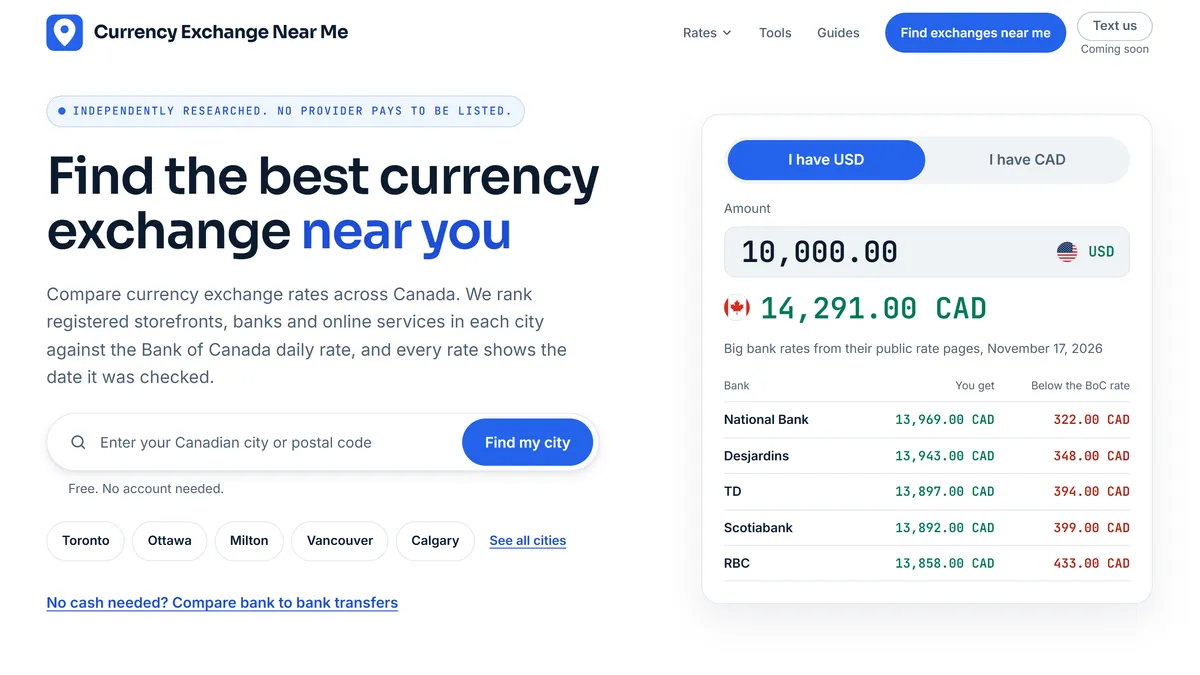
To see how current providers compare for your amount, open the currency exchange comparison and check each rate against the Bank of Canada figure for that day.
Key takeaways
- A multi-currency account is only as good as its conversion rate.
- Ask for an all-in quote in Canadian dollars and compare it with the Bank of Canada rate.
- Match the account to the use: spending, receiving income, a one-off large transfer or saving.
- Verify FINTRAC registration and CDIC membership where deposits are involved.
FAQ
Is a multi-currency account the same as a foreign-currency account?
Not exactly. A foreign-currency account usually holds one currency, such as US dollars, at a Canadian bank. A multi-currency account holds several currency balances under one login. Many people use the terms interchangeably, so check which currencies you can hold and spend.
What does it cost to convert money in a multi-currency account?
The FCAC reports that conversion markups typically run from about 1% to 4% over the mid-market rate, depending on the bank, the currencies and market conditions. Some fintechs apply lower or no markups. Add any transfer fees and, for card use abroad, the foreign transaction fee.
How do I know if the exchange rate is fair?
Compare the amount you would receive with what the Bank of Canada rate for the same day would give you. The percentage gap is your all-in cost. Do this for the exact amount you plan to convert, since fees weigh more on small sums.
Are foreign-currency deposits protected in Canada?
CDIC states that deposits in foreign currency are eligible for coverage at its member institutions. Investments such as stocks, ETFs and cryptocurrencies are not. Check that your institution is a CDIC member and see the CDIC site for the limits that apply.