The rate on an airport board is rarely the rate you would see on a financial news site, and the gap is where the cost sits. For US dollars, the Bank of Canada’s Daily Digest reported USD/CAD at 1.4257 for November 13, 2026. That is an indicative reference, not a quote anyone has to honor. Whatever an airport counter offers above that figure, plus any commission, is your real cost. This guide shows how to measure that cost in Canadian dollars before you hand over cash, and when a different route is the better fit for your amount.
TL;DR
-
The Bank of Canada’s indicative USD/CAD rate was 1.4257 on November 13, 2026. Compare any airport rate against the day’s published figure, because the difference is the markup.
-
A markup is the gap between the mid-market rate and the rate you are given. The Financial Consumer Agency of Canada (FCAC) puts typical bank markups at roughly 1% to 4%.
-
Airport and train-station kiosks commonly offer worse rates than banks and exchange services, even when no separate fee is advertised.
-
Ask for the number of Canadian dollars you will pay for the exact foreign amount you want. That single figure includes the rate and every fee.
-
For large or repeated amounts (snowbird transfers, property, tuition), cash at an airport is the wrong tool. Compare transfer providers instead.
Table of Contents
How airport exchange rates are built
Every currency quote has two parts that matter to you: the exchange rate and the fees. Both change what lands in your hand.
The starting point is the mid-market rate, the midpoint between what buyers and sellers in the wholesale market will pay. The Bank of Canada publishes a daily reference. It says it releases daily average rates by 16:30 ET on days its Ottawa Head Office is open, quoted as the Canadian dollars needed to buy one unit of foreign currency. The same page says these rates are indicative, are derived from aggregated financial-institution quotes, and may differ from the rates financial institutions actually offer. Treat the figure as a yardstick, not a promise.
From there, a provider adds its margin in one or both of two places:
-
The spread (markup). The FCAC defines currency-conversion markup as the difference between the mid-market rate and the rate applied to your transaction. It is built into the rate, so it never appears as a line item.
-
A commission or service fee. This is charged on top, either as a flat amount or a percentage. NerdWallet Canada notes that a spread may be embedded in the rate while a separate commission is added on top, which is why “no commission” does not mean “no cost”.
Airports add a third factor: convenience. You are buying at a moment when your alternatives feel limited, and the posted rate reflects it. Neither a board that says “0% commission” nor a high-looking headline rate tells you the total. Only the final Canadian-dollar amount does.
A worked example: US$1,000 at the airport

Take the Bank of Canada’s November 13, 2026 reference rate of 1.4257. At that rate, US$1,000 is C$1,425.70 with no markup. No retail provider will give you exactly that, so the question is how far above it you pay.
The table below illustrates the FCAC’s 1% to 4% range for bank markups. It is arithmetic on the reference rate, not a quote from any airport or bank.
| Markup over the reference rate | Effective rate (C$ per US$1) | Cost of US$1,000 | Extra cost vs reference |
|---|---|---|---|
| 0% (reference only) | 1.4257 | C$1,425.70 | C$0.00 |
| 1% | 1.4400 | C$1,439.96 | C$14.26 |
| 2% | 1.4542 | C$1,454.21 | C$28.51 |
| 4% | 1.4827 | C$1,482.73 | C$57.03 |
The FCAC publishes its own example for a transfer: sending US$1,000 through a Big Six bank at C$1.4607 per US dollar costs C$1,460.70 before any transfer charge, with a C$0 transfer fee and an estimated markup of C$39.70. That is the same pattern: a zero fee on paper, a real cost in the rate.
Two habits make this arithmetic useful at a counter:
-
Divide the Canadian dollars you would pay by the US dollars you would receive. That gives the effective rate, including fees. Compare it with the day’s reference.
-
Check the date of the reference. Rates move daily, so a figure from last week is not a fair comparison.
Airport versus bank: what the evidence says
The fairest summary is that airport kiosks tend to cost more than the alternatives, while banks sit in a middle band that is not always disclosed.
Airport and station kiosks. NerdWallet Canada’s guide says kiosks at airports and train stations commonly offer worse rates than banks and exchange services. The convenience premium is built into the spread.
Banks. The FCAC says Canadian banks disclose the applied exchange rate but generally do not disclose the markup as a separate cost. Estimated markups typically run from about 1% to 4%, depending on the bank, the currency pair, and market conditions. You have to calculate the markup yourself, using the method above.
Bank counters inside airports. Some airport counters are run by banks, and their terms can differ from independent kiosks. Toronto Pearson’s currency exchange page says its bank-operated counter uses that bank’s foreign-exchange rates and adds no additional transaction charge on top of the rate, though account transaction fees may still apply to deposit-account clients. The same page describes limits of C$9,999 equivalent for the bank’s clients and C$2,999 equivalent for non-clients, and notes that currency availability may change. Even with no extra charge, the cost still sits in the rate, so run the same effective-rate check.
If you are comparing your own bank with other providers on the CAD to USD pair, our CAD to USD bank comparison puts rates and fees side by side against the Bank of Canada reference.

Other ways to get foreign cash, and what each costs
Cash at the airport is one of several routes, and each has its own fee structure. It helps to know them by type.
| Route | Where the cost sits | Best suited to |
|---|---|---|
| Airport kiosk or counter | Spread in the rate, sometimes a commission | Last-minute small amounts |
| Bank branch (order ahead) | Undisclosed markup in the rate, sometimes a fee | Planned trips, known amounts |
| Local exchange storefront | Spread, sometimes a commission | Comparing in your own city before you travel |
| Credit card abroad | Conversion rate plus a foreign-transaction fee | Purchases, not cash |
| Destination ATM | ATM-operator charge plus your bank’s fees | Topping up small amounts |
Two of these carry fees that stack on top of the rate:
-
Credit cards. NerdWallet Canada says most Canadian credit cards charge a foreign-transaction fee, usually 2.5%, on non-Canadian-dollar purchases. It’s in addition to the conversion rate and spread, and some cards don’t charge it.
-
Destination ATMs. The same guide says withdrawals can involve ATM-operator charges plus your bank’s foreign-exchange, conversion or out-of-network fees.
The practical point is that no route is free. Each one hides its cost somewhere else, so compare totals, not headline rates.
How to compare before you fly
A five-minute routine beats any rule of thumb. Work through it a few days before departure, when you can still choose where to exchange.
1. Fix the amount and the currency
Decide how much foreign cash you actually need. Most trips need less physical cash than people expect, because cards cover many purchases. Over-exchanging means you pay a spread twice if you convert leftovers back into Canadian dollars at the end of the trip.
2. Note the reference rate and its date
Look up the Bank of Canada’s published rate for your currency pair. Write down the date. Our USD to CAD rate page shows the pair with its date, and our historical exchange rates page shows monthly and yearly averages since 2017 if you want to see whether today’s level is typical.
3. Collect two or three all-in quotes
For each option, ask one question: how many Canadian dollars will I pay for exactly this many foreign dollars, with every fee included? Do not accept a rate on its own. A quote with a good-looking rate and a flat fee can cost more than a plain quote with a weaker rate, depending on the amount.
4. Calculate the effective rate and the markup
Divide Canadian dollars paid by foreign dollars received. Then divide that by the reference rate and subtract one. If the reference is 1.4257 and your effective rate is 1.4542, the markup is about 2%. This is the same figure the FCAC calls the markup, calculated from your own quote.
5. Check the limits and availability
Counters can cap how much you exchange and may not hold every currency. Pearson’s page, for example, lists separate limits for clients and non-clients and says availability may change. Confirm the amount and currency are in stock before you rely on it.
6. Leave airport exchange for small, unplanned amounts
If you are already past security with no cash, a small airport exchange is a reasonable stop-gap. Keep it to the minimum you need to reach your destination, such as a taxi or a first meal.
When the amount is large, cash is the wrong question
Most readers who come to us aren’t buying a few hundred dollars for a week away. They are moving money for a purpose, and at those amounts the percentage matters far more than the convenience.
-
Snowbirds moving funds south for the winter.
-
Homeowners buying US property, and Canadians selling it and bringing the proceeds home.
-
Cross-border workers paid in US dollars who convert regularly.
-
Students paying US tuition.
An airport counter is not built for any of these, and many have caps. Pearson’s published limits, for instance, top out at C$9,999 equivalent for the bank’s own clients. Beyond that, you are comparing transfer routes, not cash counters.
The percentages add up on repeated transfers. The FCAC’s example for monthly US$1,000 transfers estimates annual costs of C$476.40 through a Big Six bank and C$113.52 through a fintech provider. Those figures describe transfers, not airport cash quotes, but they show how a few percent gap becomes a visible cost over a year. On a single large transaction such as a property purchase, a markup at the upper end of the FCAC’s range on US$300,000 would be many thousands of dollars, so the comparison is worth doing properly.
If this is your situation, our Canadian snowbird money guide covers US banking, exchange and tax, and the same all-in method applies: total Canadian dollars out, total US dollars in, against the day’s reference.
Where our comparison fits
Currency Exchange Near Me is an independent comparison site for Canadians exchanging Canadian and US dollars. We compare the rates and fees of Canadian banks, online money transfer services, and local exchange providers against the Bank of Canada’s daily rate, so you can see the cost before you commit. Every listing is independently researched; no provider pays for placement or ranking, and each provider is checked in the FINTRAC registry and scored on its BBB rating, published rates, and customer reviews. Each comparison shows the date it was checked, and our methodology page explains how we score.
For cash, start with the city where you live: our city guides to currency exchange cover every major Canadian city, including Toronto and Calgary. Comparing at home before you head to the airport is the simplest way to avoid paying the airport premium.
We earn affiliate commissions from some providers; our disclosure page explains how.
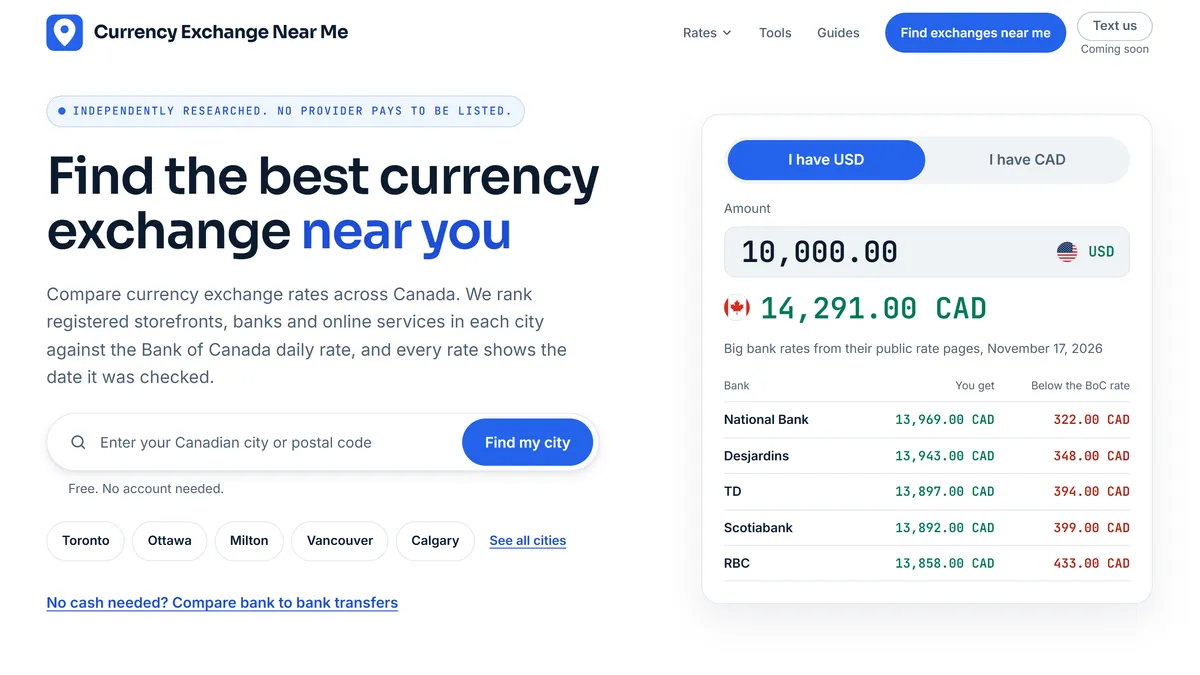
Ready to compare? See the best currency exchange options near you in Canada with rates checked against the Bank of Canada reference and dated.
Safe habits at any exchange counter
Beyond price, a few checks protect you in Canada.
-
Confirm registration. Money services businesses in Canada register with FINTRAC, the federal financial intelligence agency. Our listings show registration status, so you don’t have to look it up provider by provider.
-
Count before you leave. Check the cash and the receipt at the counter, and make sure the receipt shows the rate and any fee.
-
Watch the bill mix. Ask for denominations you can use easily, since small bills are more useful for tips and transport.
-
Do not exchange back at the end. Leftover cash converted at the airport on the way home pays a second spread. Spend it or keep it for your next trip.
FAQ
Is it best to do currency exchange at the airport?
Usually not, unless the amount is small and you need it immediately. Kiosks at airports and stations commonly offer worse rates than banks and exchange services. Compare the all-in cost, in Canadian dollars, against the Bank of Canada reference before you decide.
How do I tell if an airport rate is fair?
Divide the Canadian dollars you would pay by the foreign dollars you would receive, then compare that with the day’s Bank of Canada rate. On November 13, 2026, that reference for USD/CAD was 1.4257. The percentage above it is your markup. Remember the Bank of Canada describes its rates as indicative, so it is a benchmark, not a guaranteed quote.
Are airport rates different from bank rates?
They can be. Banks show the rate applied but, according to the FCAC, generally do not disclose the markup separately, and estimated markups range from about 1% to 4%. Airport kiosks add their own margin. Either way, the effective-rate calculation tells you which is cheaper for your amount on the day.
Is a credit card cheaper than exchanging cash?
It depends on the card. Most Canadian cards charge a foreign-transaction fee, usually 2.5%, on top of the conversion rate, while some cards charge nothing. Check your card’s fee before you travel and compare it with an all-in cash quote.
How much cash can I exchange at an airport counter?
It depends on the counter. Toronto Pearson’s page describes limits of C$9,999 equivalent for the bank’s clients and C$2,999 equivalent for non-clients at its bank-operated service, and notes that currency availability may change. For amounts above typical counter limits, compare transfer options instead.
Sources
-
Currency conversion markup, Review of banking fees, Financial Consumer Agency of Canada
-
Background information on foreign exchange rates, Bank of Canada
-
Everything passengers need to know about currency exchange at Pearson, Toronto Pearson
-
Exchanging Canadian Currency: How to Find the Best Rates, NerdWallet Canada